
Girls, Physics and Planet Possibility

by Christina Astin @ChristinaAstin (Chair of Planet Possibility), Marilyn Comrie @GetMeMotoring (Director of The Blair Project) and Olivia Keenan @oliviakeenan1 (SEPnet and QMUL).


Some young people, including girls, are put off studying physics because of misconceived stereotypes.

Planet Possibility is a consortium working to change this, radically.

We want to highlight the gender imbalance in physics, tell you what the Planet Possibility consortium and others are doing to address it and what education leaders can do to help.

What are the first three words that come to mind when you hear the word "physicist"?

Fig 1 below shows a Google image search for "physicist". Does it confirm or shatter your own opinion?
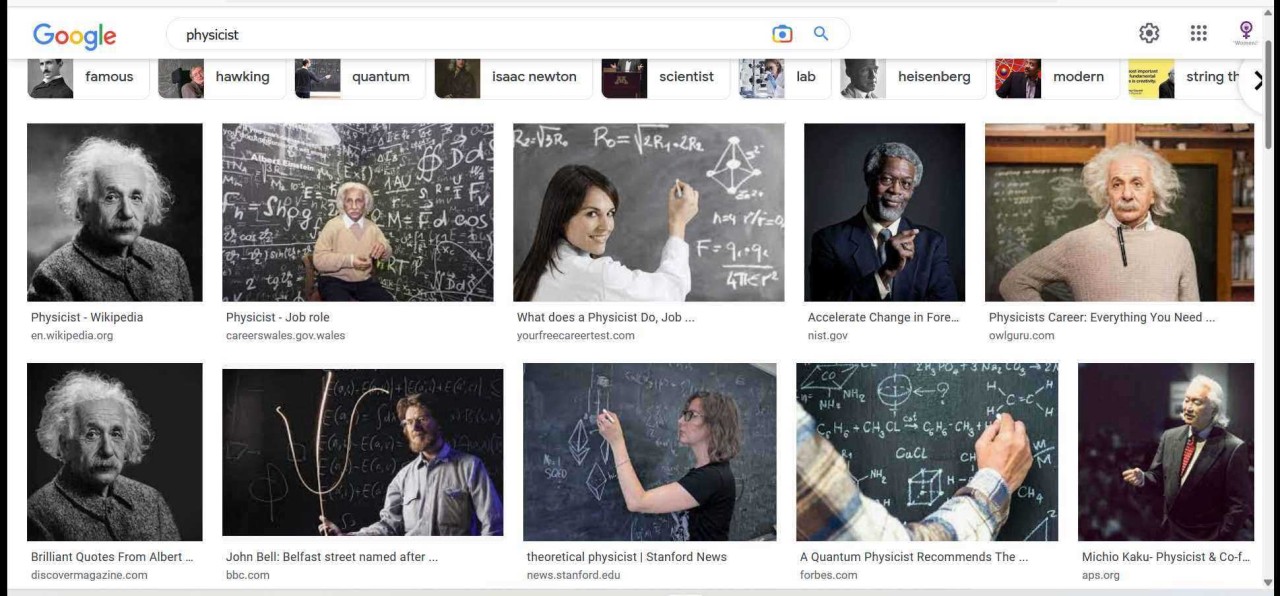
Fig 1. Google image search for "physicist" conducted October 2022.

To those of us working in physics this group of images is pretty disappointing: it reinforces the image of physics as the preserve of dead white males. And a subject which still uses chalkboards!

Parents and carers were asked to describe someone who does physics, and Fig 2 below shows a word cloud representing their responses.
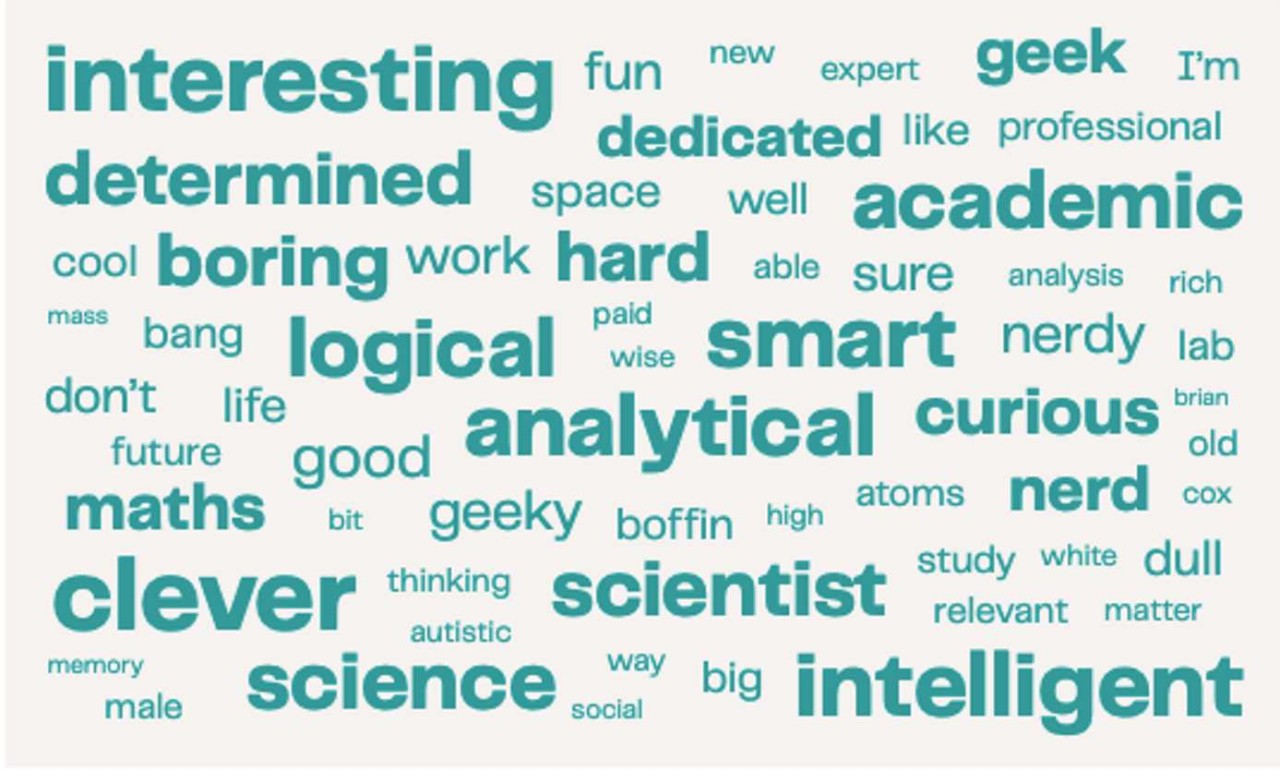
Fig 2. Word cloud made from the words parents and carersprovided when asked to describe someone who does physics.(IOP Limitless 2020)

What about gender imbalance in the classroom? The Aspires 2 project worked with children aged 10 to 18. The research found that girls often did not feel "clever enough"to do physics, even though girls achieve similar grades to boys, and felt that teachers had lower expectations of them and were less interested in how they performed.

We know that the proportion of girls studying A-level physics in the UK has been stubbornly low for over 20 years at around 20%. There are also inequalities in social background, ethnicity and disability. And this imbalance follows through into the world of work where women make up only 22% of the STEM (Science, Technology, Engineering and Maths) workforce .

Some might ask why this is a problem? 

To start with, the UK has a shortfall of STEM professionals – around 60,000 engineers per year are needed, for example. But it's not just about UK plc. We need more physicists to meet global challenges: tackling climate heating, developing artificial intelligence, designing energy storage solutions. Teams solve problems better when they are more diverse. And anyway, we should ensure that this large proportion of the population are not put off physics for the wrong reasons: perhaps working in physics would bring them the fulfilment they are currently being denied.

Addressing this as part of the solution is Planet Possibility , a consortium made up of universities (Birmingham and Southampton), charities (Future First and The Blair Project) and a business (the All About Group). Together, these organisations boast vast experience in the areas of diversity, inclusion, engaging with young people, STEM, physics, careers and digital projects.

Together, the consortium will:

  • Provide a greater diversity of young people with access to physics specialists and role models – including traditionally under-represented groups, including girls;
  • Provide greater support for physics teachers;
  • Encourage and develop talent into academic & technical physics-based careers

Through a digital platform, the consortium plans to extend its reach through events, webinars, content, games, guides, jobs, work experience, mentoring and other tools and channels to help create a flourishing physics community.

Planet Possibility is funded by the Institute of Physics' Challenge Fund to help deliver their strategic aim of improving the diversity of people doing physics in education, research and industry.

One of the consortium partners, The Blair Project, works with young people of mainly BAME backgrounds, originally around Manchester. It was started by two brothers, Nile and Blair Henry who gave schoolchildren the opportunity to retrofit electric motors in go-karts – learning about green energy while tinkering!

Now, as part of the consortium, The Blair Project is offering a range of activities to engage this traditionally underrepresented group:

  • BAME online Physics Clubs providing safe spaces for science and tech geeks of color to engage with others like themselves, to feel less isolated, and overcome the peer pressure that physics isn't cool.
  • Interactive activities to bring physics to life through tinkering and hands-on learning, engaging TikTok physics videos, inspirational talks from role models of colour.
  • A bi-monthly See Me Be Me podcast hosted by Nile and Blair Henry
  • Industry visits to employers to broaden horizons and deepen understanding of the range of existing and emerging careers.
  • Growing awareness amongst parents, carers and the wider public of the role of physics in solving global challenges.

Another partner, Southampton University, is part of a network of 9 university physics departments, SEPnet, working together to widen access to physics. Olivia Keenan from Queen Mary University of Londondescribes their work streams as:

  1. Decolonising undergraduate curriculums across their university partners
  2. Assessing the BAME awarding gapacross their partners
  3. Running gender and science identity programmes with schools
  4. Advising the exam board AQA of diversity in their Physics specifications

The third of these includes a school-based project called Shattering Stereotypes, involving multiple interventions for year 8 students. It raises awareness of gender stereotyping in young people and equips them with tools to deal with this and offers supplementary teacher CPD to improve gender balance in classrooms.

So, how do we help to encourage girls to consider physics beyond age 16? Our call to action for school leaders is this, and benefits all learners, not just girls:

  1. Good quality teaching -Recruitment and training, focus on specialist physics teachers, encouragement of 'tinkering'!
  2. Whole school gender policy- Challenging unconscious bias in curriculum; ensuring appropriate and consistent language.
  3. Access to role models - We can't be what we can't see – careers role models open up a world of possibility for young people.


This is a blog based on a talk given at the #WomenEd Global Unconference on Saturday 1st October 202


Notice from #WomenEd:

We invite you to comment on our blogs; we are always delighted to hear from you. To do so, scroll to the bottom of this page and send in your comment with your name and email.

Thank you!

Growth – Personal and Professional

Representation of more women leaders in education, including more diverse leaders, has always been front and centre to #WomenED. 

When our community began to grow, this was because we were all developing our confidence to call out the barriers that hold women back and to bring about change.

Congratulations to our wondrous #WomenEd community as we have all have done a brilliant job with this.

We really want to build on our confidence and open more opportunities for professional growth and development which also support our personal growth and increases the Representation of women leaders significantly

So here are 4 development opportunities tailored for you:

1.     #WomenEd Senior Leader cohorts in partnership withNational College of Education (England only) 

This is our first collaboration to increase Representation and it's both joyous and extremely successful. 150 women have been part of this so far with personal and professional success off the charts! It's an Apprenticeship / Masters pathway supported by monthly sessions with the #WomenEd cohort to explore leadership through the lens of a women. And it's FREE for most schools paying the Apprenticeship Levy (why it's only for England). We reserve 20% of the places for women with an ethnic heritage and those from underrepresented groups.

The next cohort starts in November 23 and the application window is open! Apply here to ensure a place in our cohort and enjoy all the amazing words from previous participants.

2.     #WomenEd cohorts for NPQH in partnership withLeadership Learning Securing Excellence. (England only)

Such success in our collaboration with The National College spurred us on to address the fully funded NPQH route so women leaders have a pathway to this qualification. 

This is a pilot cohort starting in October 23 specifically championing and elevating women leaders.

To begin an application, please complete this short registration form.

When applying first select NPQH and then the relevant Delivery Partner and Cluster.

DP selection -University of Wolverhampton

Cluster selection -WomenEd

LLSE will then be in touch with login details and request some additional details to complete your application via your LLSE account.

3.      #WomenEd cohorts for the Coaching Professional Apprenticeship with@CVPGROUP

This new offer supports the interest in coaching in our community and the qualification enables you to apply your coaching skills in the workplace.

We are also pleased to open this programme to women beyond England on a self-funded basis: get in touch withYasmin.

We are delighted that we have a full cohort already for September 23 with applications now open for March 2024!

Full details are in the blog!

4.      #WomenEd Global Unconference IN-PERSON, in London

30th September is an opportunity for our community to come together in person! It's London this year and which country will be next year?

Come to listen and engage or offer to speak as well! We hope very much that as many of our global community can come and join in.This is personal and professional growth with bells on and we want disruption on a huge scale!

Full details are here including booking tickets and offering to speak.Let us know if you would appreciate a creche also and we will see what is possible in terms of numbers.


Development the #WomenEd way.

In choosing our partners for these opportunities, we look carefully at their values and with whom we would be working. We work to ensure the curriculum is inclusive and, where necessary, augment it with alternative perspectives, readings, and contributors. We appreciate the flexibility offered by these partners to customise the offer to women leaders. It is great to work with brilliant women leaders in tailoring these programmes and many thanks to Rachel, Nicola, Lizana, and Yasmin.

Support other Women!

If you have any colleagues who you think may be interested in applying for and joining these opportunities, please share this information with them.

It's what we all do, it's the #WomenEd way to growth.


Harnessing the Potential of the Profession #BreaktheBias

by  Liz Free @LizAMFree

During International Women's Day 2022 (#IWD22) we were invited to imagine a gender equal world. 

A world free of bias, stereotypes and discrimination. 

A world that is diverse, equitable and inclusive. 

A world where difference is valued and celebrated. 

The focus was around women's achievements, raising awareness against bias and taking action for equality.

How many of our international schools discussed this and celebrated #IWD22 in some way? From the social media streams of most international education organisations, we saw a flood of support, commentary and engagement.

However, how equitable are our schools and education organisations? Sadly, the picture in international education is not bright. The data speaks for itself and we can quite safely say that there is not gender equity in the international school world.

This is such a contradiction for so many of us when we have mission and vision statements that talk about equity, diversity and representation. Our schools have HR policies and codes of conduct that talk about discriminatory practice being unacceptable. We need to have an honest look at our own organisations, to reflect on the actual data and start with ourselves, if we are truly engaged with breaking the bias for gender equitable schools.

In January the Council of International Schools (CIS) published their annual 'Analysing Head of School Salary Gaps'. It does not make comfortable reading. The report concluded that 'for a fourth consecutive year, the findings make evident a gender, ethnicity and contract category [local or International hired] salary gap' (CIS Research – Head of School 2022 Salary Gaps, 2022).

One may well conclude that this is merely a microcosm of the global education system that doesn't reflect the whole, but it is not. The international education market is significantly behind that of domestic systems. Over two-thirds of the global profession are women and yet 'women in education leadership account for less than half of school leadership' (Free, 2019); women in education leadership represent just below 50% of all leaders which is vastly disproportionate to the number of women in the profession.

In the international school market, we see the number of female school heads at 28% of the overall number of school heads. This puts the international school gender leadership gap even wider than the global average. This gender inequity also reaches beyond a place at the school leadership table and extends into pay as well.

In reviewing the CIS data, heads of school that are female earn, on average, 12 433 USD less when compared to their male counterparts (average = 137 681 USD for men and 125 185 USD for women).

This data also exposes an even more statistically significant bias when looking at white and non-white leader salaries. The ethnicity salary cap between white and non-white heads of schools is 33 860 USD. But, this is not the worst. The gap is even wider when considering internationally-hired or locally-hired heads of schools; the contract salary cap sits at 39, 246 USD.

In #WomenEd, a global network of over 40,300 people looking to develop gender equity in education leadership, we advocate for the global profession and work to eliminate inequities and to encourage more women into education leadership.

We invite all international schools to join us in this endeavour as we seek to have our own international school houses in order. Let's start by modelling equity in the staffing of all schools and organisations.

Let's work together to #breakthebias and have truly gender-equitable schools.


References:

calameo.com. 2022. CIS Research – Head of School 2022 Salary Gaps. [online] Available at: <https://en.calameo.com/read/0047013021bc410949b83?authid=7qNWGYj4hzId&gt; [Accessed 10 March 2022].

Free, L., 2019. International Perspectives. In: V. Porritt and K. Featherstone, ed., 10% Braver Inspiring Women to Lead Education, 1st ed. London: Sage, p.41.

First published in Independent Education Today on 23rd March 2022


Notice from #WomenEd:

We invite you to comment on our blogs; we are always delighted to hear from you. To do so, scroll to the bottom of this page and send in your comment with your name and email.

Thank you!
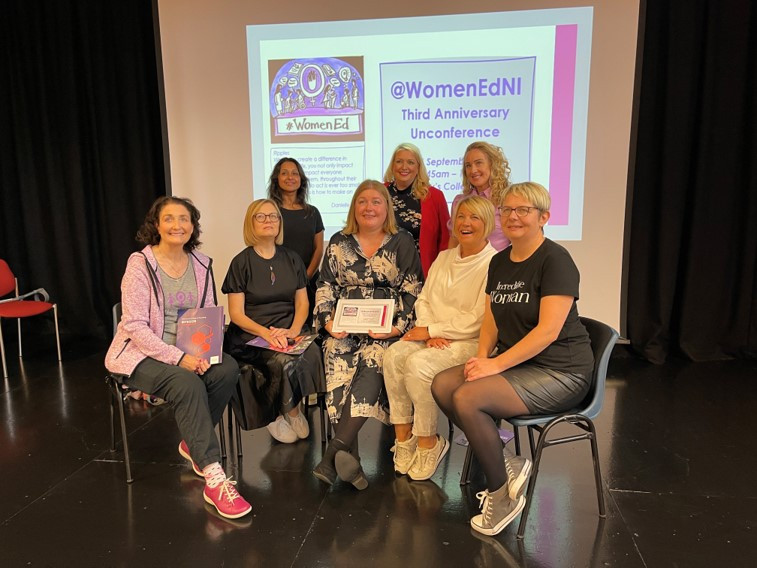
Honouring Parm Plummer: A champion for #WomenEd Northern Ireland

From all of us in the #WomenEd NI network, we want to extend a heartfelt thank you to Parm Plummer for her dedication and support to our community.

Many in our network might not realise the extent of Parm's behind-the-scenes efforts, but her contributions have been invaluable to us. Regardless of the time, Parm has always been just an email or a message away from offering support and guidance.

We're particularly grateful for Parm's assistance in taking several of our network leads through their orientation process. Her leadership and guidance laid the foundation for this thriving WomenEd NI movement, and for that, we are eternally thankful.

Her dedication is evidenced by holding the undisputed record for the furthest trek to a #WomenEd NI unconference – all the way from Jersey to Derry!

(Back L-R): Parm Plummer, Róisín Rice and Amanda Murphy (Front L-R): Jackie Hill, Mary Lowery, Hannah Wilson, Geraldine Duffy and Mairéad Mhig Uaid

Even when she couldn't physically attend, her night-before or morning-of messages of warmth and encouragement always set the perfect tone for a day of learning and connection with our community.

Parm has been a constant ally and dynamic force of empowerment for women in education - a role we know she will continue to embody.

Thank you, Parm, and best wishes in all of your future endeavours.

Your friends at #WomenEd NI.

I am woman, hear me roar!

by Lisa Hannay  @lhannay1

Vivienne Porritt and I collaborated on the piece below for a possible submission into a book designed to amplify tiny voices. Now, it didn't get selected but we use the #WomenEd platform to grow a network of empowered women, create impact on the status quo and carve a large dent in the patriarchy! Connect with @WomenEd on Twitter!

As the story goes, or maybe it is legend now, a group of 7 educators started a conversation on Twitter about the lack of representation of women in leadership roles, gender pay gaps, gender equality and how they might make a difference. These women were wholly focused on the situation in England, never imagining where their conversation may lead. These 7 educators met in May 2015 for afternoon tea at a hotel in Bracknell in the South East of England. Of course, we all think it was gin that lit the fire, but this 'most English of traditions' (Wilson, 2019:3) began a movement that has now crossed the globe.

'One woman alone has power; collectively women have impact'(Zalis in Forbes, 2019).

#WomenEd has had just this kind of impact and there is no end in sight for what this grassroots organization will accomplish. Since its inception, several sister groups have been created, each network amplifying the voices of a few to the collective roar of many. The metaphorical table has had to add many more seats, far more representative of society at large, and the table is far better for it. 

#WomenEd now has over 44,000 followers on Twitter, maintains numerous partnerships, has built 37 networks around the world, held over 300 events, written more than 250 blogs, and has published two books, all due to uniting and amplifying the individual, tiny voices of women leaders.

It would be understatement to say that discontent and inequality forged this network of women educators and leaders. In every network that has since been created the statistics are similar. Women make up most roles in the classroom, yet their advancement into middle and especially senior leadership positions, is much lower. 

Systemic, cultural, personal, societal, and family pressures and obstacles are often in place that keep women from smashing the glass ceiling. For women of colour, the glass ceiling is often more of a concrete ceiling (Choudry in 10% Braver: Inspiring Women to Lead Education, 2019). 

In a Forbes article, Why Women Need to Network Differently Than Men to Get Ahead, Caroline Castrillon explores how women can advance professionally. Women focus on creating personal relationships and an 'inner circle of women' on whom they rely for professional and personal advice and support. 'The support system and gender-specific advice that women can provide to other women are crucial to career advancement.' (Castrillon, 2019). #WomenEd does exactly this type of networking. 

Anna Powers (2019) adds that women seek out diversity in their networks which helps them overcome blind spots and cognitive biases, thus reducing weakness, leading to an expanding point of view and open-mindedness. Diversity is part of the vision and values of #WomenEd and we seek out all the various voices, inviting blogs, videos, presentations, and speakers at our unconferences to ensure that all perspectives are heard.

It could be said, in fact, that #WomenEd serves as the megaphone for the amplification of a multitude of tiny voices. These voices unite on Twitter, from @BAMEedNetwork, to @LGBTedUK, to @DisabilityEdUK. Also, there are numerous groups that grew because of their connection to #WomenEd, such as @maternityCPD and @FlexTeachTalent

There is no one voice that dominates #WomenEd and no real hierarchy. Many women connected with #WomenEd have gone on to publish books with topics ranging from headship to equity in education. These publications are celebrated through @WomenEdBookclub. There is no competition, no leader, but a group of seven women who support all the networks, ensuring that the integrity of the organization remains intact. 

We would even go as far as to say we seek out all the tiny voices. What often starts out as a whisper, we have learned, slowly grows to a roar. Toria Bono in her blog 'Teaching Others and Learning All the Time', states that there are 'big people with big voices' in education but she campaigns to have the tiny voices talk to other tiny voices.

#WomenEd has published two books:

The first, 10% Braver: Inspiring Women to Lead Education, discusses the barriers women face when pursuing leadership: the gender pay gap, flexible working, or the lack thereof, imposter syndrome, lack of representation of women of colour, home-school balance, and navigating the work force. 

The second book, Being 10% Braver, relates the real-life narratives of women who have been that little bit braver and pursued leadership, often battling against discrimination, unconscious bias, stereotyping, the motherhood penalty, and an array of other issues which hold women back from attaining leadership roles. 

#WomenEd put out calls for contributing authors for Being 10%Braver and many of the authors are first time writers. The #WomenEd books are often described as accessible and empowering. Readers can relate because they can see themselves in the stories. Readers can relate because they can hear their voices in the narratives presented, particularly in Being 10%Braver.

The essence of #WomenEd lies in its values and vision. 

Central to these values is supporting aspiring women leaders and modeling the 8 C's – clarity, communication, connection, community, confidence, collaboration, challenge, and change. Empowered women empower other women and meet women where they are at in their journey. 

#WomenEd 'is about people, relationships, storytelling and their impact.' (Wilson 2019:5). #WomenEd's values come alive during their events and annual unconferences, either in person or virtually. Women from around the world contribute their perspectives, their ideas, and their experiences. Regularly, women express that they mustered up courage to participate in panels or sessions because other women also expressed the same sentiment and had presented previously. This bravery is contagious and, unlike many mainstream educational conferences, the sessions are accessible, relatable and there is broad representation of all voices. At these sessions, #WomenEd makes space for people to be heard and encourages senior leaders to ensure that they create cultures where women can be heard. As Hilary Goldsmith states, 'I dug deep into my bravery bank account, found the cash to buy my own chair, plonked it down at the edge of the table and …astonishingly, everyone shuffled to make room.' Being 10%Braver.

That table was #WomenEd. 

Whatever the metaphor used, the #WomenEd community is welcoming, supportive and speaks powerfully with and for all tiny voices.

#WomenEd uses Twitter as its main social media platform. It is easy to collect evidence about the impact of the organization and its individual members by simply reading and collecting tweets. These tweets often talk about women finding and learning how to use their voices to change and challenge the status quo and the landscape of leadership. 

From August 10, 2018, 'Your impact is immeasurable. Your life experiences have made you stronger and we have become braver because of you. Fairness is more than just equality; it is about empowering so that voices are really heard bringing about change without changing the self.' (Jamill, personal communication, 10 August 2018). 

In 2018 there was a blog challenge (#pledgeforchange) and many of the blogs were written and published by first-time authors. These blogs talked about being brave, being true, being authentic and finding a voice. Looking at this qualitative data, it seems clear that when tiny voices find themselves, bravery soon follows, and these tiny voices become change-makers. Charlie Kraig, in a blog from March 2020, says 'When we come together as women, as leaders, as people determined to make our world a better place for everyone, there is power in that.' (Power of Connection #IWD2020, 8 March 2020)

#WomenEd continues to grow and expand its impact. Working on a possible third book, #WomenEd will seek out voices that have not yet been heard and is always honored when asked to contribute to articles, blogs, books, workshops, and conferences. 

#WomenEd will continue to challenge, change, and champion women to find and use their voices to create a world where women can be who they are, and feel acceptance, regardless of gender, race, religion, orientation, age, or size.

#WomenEd will continue to be the megaphone for the voices that need to be heard and provide the platform for the words and ideas that need to be visible.


Notice from #WomenEd:

We invite you to comment on our blogs; we are always delighted to hear from you. To do so, scroll to the bottom of this page and send in your comment with your name and email.

Thank you!
Jacinda Ardern: a very human leader

By Viv Griffiths

Jacinda Ardern's resignation announcement last week, without apparent prior warning, naturally came as a shock. She gave a characteristically honest and at times emotional speech explaining her reasons for stepping down from her role as prime minister of New Zealand:

"Politicians are human. We give all that we can, for as long as we can, and then it's time. And for me, it's time… I know what this job takes, and I know that I no longer have enough in the tank to do it justice."

Compare this speech and overall leadership style with the macho posturing of Boris Johnson and Donald Trump, both of whom shamelessly clung on to power and, of course in Trump's case, fired up his supporters with false allegations of voter fraud after losing the 2020 US election.

Being "exactly who I am"

To many, Ardern came to prominence from nowhere in 2017, when she unexpectedly had to take on the leadership of Labour and then the country, although she had in fact been involved in politics for over 15 years when she took office. When elected as prime minister at 37 years-old, she was the world's youngest female head of government, and later became only the second world leader to give birth while in office.

It's interesting to compare her speech, when taking on the Labour leadership, to her resignation speech. In a 2017 interview, she said: "I had to run the campaign as myself, be exactly who I am, run a lot based on instinct."The 'what you see is what you get' attitude, a human approach without artifice, was strong from the outset.

This could have come over as naivety, but Ardern was no pushover. When challenged early on about whether she planned to have children, she told a TV host in no uncertain terms that it was "totally unacceptable in 2017 to say that women should have to answer that question in the workplace. It is unacceptable." Double standards for women in the workplace continue to beset even those – or particularly those – in the highest office.

'Compassionate but tough'

A combination of emotion and strength has characterised Ardern's leadership style throughout and stands out as particularly impressive and unusual.

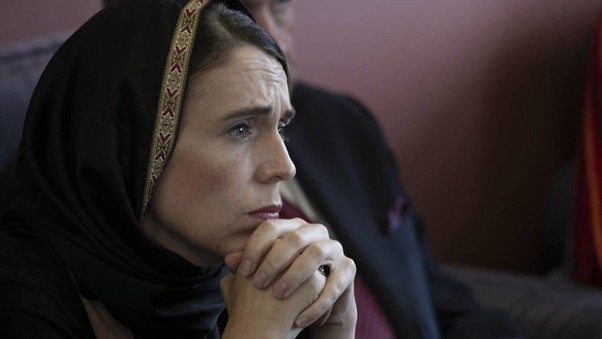
An often-cited example of Ardern's empathy was her response, acclaimed world-wide, after the terrible shooting incidents in 2019 at two mosques in Christchurch left 50 dead. She quickly labelled the incidents as terrorism, and met members of the Muslim community the next day, respectfully wearing a hijab and hugging victims' families. This was swiftly followed by an announcement that military-style semi-automatic weapons and assault rifles would be banned, earning her the accolade internationally of being "compassionate but tough."


‘Compassionate but tough’. Jacinda Ardern in the aftermath of the Christchurch mosque shootings, 2019. Photo credit: appaIoosa, CC BY-NC-ND 2.0.

This rare combination was also very much in evidence during Ardern's response to the Covid pandemic. Ardern was widely praised for introducing stringent Covid-elimination strategies. After the first cases were identified in March 2020, Ardern closed the country to foreigners and introduced quarantine for returning New Zealanders, plus strong internal lockdown measures soon after. There have only been 2,393 deaths in New Zealand as a result of the virus. In contrast, Boris Johnson was criticised for ignoring the problem and bringing in Covid-protection measures too late in the UK: 216,255 Covid-related deaths resulted.

Suze Wilson, from Massey University New Zealand, called Ardern's Covid response a "masterclass in crisis leadership", arguing that she used a skilful combination of strong communication and empathy, giving clear directions but acknowledging the challenges New Zealanders faced in following such strict prevention measures.

Comparing Ardern's and Boris Johnson's announcements about lockdown, Wilson argues that Boris Johnson's approach was framed as an instruction from government, with an emphasis on enforcement: "Where Ardern blended direction, care and meaning-making, Johnson largely sought compliance."Ardern's nightly Facebook livestreams to 'check-in' on citizens helped to keep spirits up, compared to Johnson's often bumbling messages – the contrast was unfavourable even before we knew that Johnson and colleagues were partying during lockdown.

The double bind for women leaders

Of course, Ardern was not without critics and her waning popularity at home has been cited as one of the main reasons for her resignation. The early 'Jacindamania' soon morphed into intensive and intrusive scrutiny of her personal life, as well as criticisms of her domestic policies.

My own research into women leaders in universities demonstrated that women in leadership roles often face additional challenges because of their gender, placing them in a double bind. In particular, the women I interviewed reported a tension between caring and authority in carrying out their roles and faced stereotyped expectations that women would be more emotional than men.

The women themselves valued caring and collegial characteristics, but sometimes tried to hide these for fear of being considered too 'soft' or unable to cope. Yet if they adopted more directly assertive approaches, they often found they were labelled as 'hard'. As American researcher E.P. Gerdes wrote: "Leadership characteristics are valued when they are possessed by men but not when they are possessed by women."

By the same author

A look at female prime ministers in the UK (all Conservative), reveals that a clear tendency to appear tough has ended up rebounding. Margaret Thatcher – the so-called Iron Lady – was accused of being dictatorial and unfeeling about the effects of the poll tax. Theresa May played up the Tories' 'nasty party' image, but was attacked for looking cold and unsympathetic after the Grenfell fire. Liz Truss was criticised for being robotic. Putting aside their largely disastrous policies for a moment, these women failed to display empathy, yet faced accusations for not doing so which their male counterparts avoided – think Boris Johnson again.

Ardern balanced this difficult tightrope in a highly skilfully manner. As she herself described it:

"I hope I leave New Zealanders with a belief that you can be kind, but strong, empathetic but decisive, optimistic but focused. And that you can be your own kind of leader – one who knows when it's time to go."


Credits

This blog originated on Sussex Bylines

Main Photo, Eesan1969, CC BY-SA 4.0 , via Wikimedia Commons

Notice from #WomenEd:

We invite you to comment on our blogs; we are always delighted to hear from you. To do so, scroll to the bottom of this page and send in your comment with your name and email.

Thank you!

Mums of boys

by Virginia Mendez @virginiamendez

First of all, I am one of you. I am the mother of a boy. I should say I'm also the mother of a girl, but since I love them both equally (as any mother does!), I trust that won't matter here. I'm an eager feminist, with a deep focus on childhood and a particular passion for masculinity. I say this so you know: I am on your side, even if it might not always seem that way.

I get it. It's scary out here. Maybe it's no worse than before, but now we have the data. Now we see it. Now we want to change it, and that makes it feel heavier.

Before, there was blissful ignorance. A script - harmful, outdated, but clear- that most of society followed. A script full of stereotypes, excuses, expectations and limited role models for masculinity. But a script.

Now, the script is breaking. For many, it's already broken. Others are clinging to its pieces, patching it up and pretending it's business as usual. There's a vacuum. A lot of questions. And again, fear.

I am a mother of a boy who, like yours, one day will be a man. A man like those I critique ruthlessly. A man like those I love dearly. My son is going to be a man, and I carry the responsibility of preparing him for that. The tools I give him now matter.

In my parenting book about gender bias, I wrote about the urgent desire to change the world once you become a parent. Because in its current form, the world is terrifying. But I also believe the best way to change the world is through our children. They will be the society of tomorrow. How we prepare them for that role is everything.

I know your son isn't a creep. I know he isn't one of those terrifying versions of men we hear about too often—the ones who rape, the ones who murder. I know he isn't even one of the annoying ones. The ones who unnecessarily touch your back at the bar. The ones taking for granted women's unpaid work in the house or the office. The ones who (un)consciously divide women into categories: wife material, sexual object or invisible.

But those men have mothers too. Mothers who will refuse to believe their sons are "those men." Of course not.

Rubiales—the ex-president of the Spanish Football Association—famously kissed Jenni Hermoso on the lips without her consent at the World Cup final. His mother locked herself in a church and started a hunger strike in protest of how the world was treating her son.

I know—you're not that mother. You wouldn't raise a Rubiales. And if by some freaky chance your son did what he did, you would be both supportive and realistic. You'd hold him accountable with compassion and kindness. You'd help him see that the world isn't wrong—he is.

But maybe part of the job is facing the possibility that our kids could become the problem. Protecting our sons from the shiny, self-indulgent, and simplistic rhetoric of misogyny is key.

I'm the mother of a daughter, and it's gutting to think she may be one of the 97% of women harassed or assaulted between the ages of 18–24. With stats like that, is not realistic to think that mine will fall in the 3% who didn't read the question properly.

I'm raising her to be independent. But I'm doing the same with my son. I want her to be confident—I believe confidence is crucial—but I want that for my son too. I'm raising both to be nurturing. Both to communicate well. Both to love unapologetically. Both to understand boundaries.

BUT—I don't pretend I'm raising them the same way to reach the same outcome. Because I am not the only factor in their upbringing. I'm not raising them in a vacuum, but in a world that CONSTANTLY and RELENTLESSLY reminds them they are a boy and a girl—and that those things are very, very different.

I raise my kids, and so do you, in a world where the boxes they're meant to fit are one-size-fits-none. Show me a child who matches 100% of the "boy" or "girl" expectations. Still, we use the parts they do match as confirmation bias. We strip them of their uniqueness and reduce them to gender.

I'm not denying that being a boy and a girl are different experiences. I am denying that those differences are mostly natural. They are mostly built by society—and we need to treat them as such. We can work around them.

Keep the good stuff, absolutely! I love that society encourages my daughter to be empathetic—great! I hate that it discourages her from expressing anger—so I challenge that. I model healthy anger. I talk (in age-appropriate ways) about how women's anger is silenced and why we need it. It moves us. Feelings tell us things.

I love that my son is encouraged to be brave and to trust his body—fantastic! But I hate that the world tells him sadness isn't his. So I go hard on creating space for that. I talk about emotions. I show him men who are comfortable with sadness, so he can be too.

Parenting boys and girls is different— but not because our children are so different, but because society treats them that way. Because the roles they must play in making a better world are different.

But unless we accept what we're fighting against, we'll let it keep happening. It will become their normal, just as it once became ours. (just as it is still for many.)

Mothers of sons, we have a responsibility. We can acknowledge how much our boys are suffering (and they are!), but we must do it honestly. We can talk about their pain while still knowing men earn more, dominate politics, the media, and positions of power. We can talk about boys' struggles without erasing their privilege. We have to hold both.

We must address what our boys are going through without pretending it's a separate conversation from the one about how men commit femicide, rape, and benefit from unpaid labour. (Even in straight couples where women earn more, they still do more housework.)

We need to understand that men are dying by suicide. That they engage in more reckless behaviour. That they delay getting help for mental or physical health. And be able to name the patriarchal structures behind this. We need to be brave enough to name the root. We need to be able to see that this conversation is part of the feminist conversation.

I care deeply about the conversation around masculinity. In fact I am OBSESSED with it. But it must be done carefully. Because done wrong, it can do more harm than good.

If we want to help our boys and make them part of the solution (for them as much as for others), we must be brave enough to face the possibility that they could become part of the problem, we must be precise with the story we tell. If we don't ask the right questions, we can't get the right answers. And yes, the right questions are harder. But they matter:

  • ⁠What got us here?
  • What is masculinity willing to give up in order to move towards where we want it to be?
  • What is everyone's responsibility with the current situation? And our sphere of control to change it?
  • How do men benefit from this system? How does this system hurt them?

And then, when we get an honest diagnosis we start looking for solutions, we try to dismantle the privilege and suffering that are so intertwined. For me, once I was able to see the whole picture, the solutions (not one but a mix of many) came easier.

It is time to admit that the old script no longer fits, and we have a role helping our sons to write a better one. They are not doomed to inherit this broken system. But they will—unless we raise them differently.

This blog is reproduced here from the original with permission from the author.

My New Chapter: Why I chose Coaching and Consultancy

As I begin this new chapter, I’ve taken time to reflect on the journey that’s brought me here. I spent 18 years in Primary Education, 13 of those in senior leadership, working alongside incredible leaders and learning deeply about myself and what it means to lead well. 

New Structure, New Opportunity to Lead

by #WomenEd Trustees

WomenEd Trustees

This year WomenEd turned ten years old; we have celebrated incredible grassroots connections, network growth and incalculable impact.

Now a registered charity, in this summer's Annual General Meeting of trustees, co-founder and legendary powerhouse Vivienne Porritt OBE chose to step away from the role of Chair, a position she has held for seven years; this follows a period of illness and although she is recovering well, it is essential she focuses on getting back to top form.

Vivienne has now taken on the role of President and will continue to advocate passionately for WomenEd, continuing also as a trustee. We cannot thank Vivienne enough for her incredible leadership.

For the year ahead, Keziah Featherstone will be Chair and Treasurer; Christalla Jamil will be Vice-Chair; Liz Free will be Secretary; with Natasha Hilton, Nancy Lhoest-Squicciarini and Olyvia Shaw continuing as Global Leaders, the main connection to the hundreds of Network Leaders and thousands of members around the globe.

New Operating Structure

Our model up until this point has been to create smaller regional or thematic teams who collaborate to support current and aspiring women leaders in their particular context. The rational for this has been that many hands make light work when we are nearly all also holding down day-jobs and juggling home responsibilities; and the support women leaders in Liverpool may need is very different to Berlin or Abu Dhabi.

Going forward, we will continue to support networks who prefer working collaboratively, and will be introducing the option for individuals to become active WomenEd Leaders without the need to find a team. More details for interested people can be found on our website, womened.com

Additionally, we are mindful that our ability to commit to being an active WomenEd Leader comes and goes. Starting a new role, having a child, being ill or a geographical move can all affect how much time there is left over to spend on organising events and supporting others. A nagging email from WomenEd is the last thing that you need after what may have been a stressful week.

However, now we have charitable status, that comes with the need to account for every penny and be able to document the impact we have. Therefore, we are slightly adapting the way that we will operate from January 2026.

Whether you are a current Network Leader or wish to become one, we will need you to (re)share your contact details and commit to organising at least one event for International Women's Day 2026, Sunday 8 March 2026, and one other event during the course of 2026.

This may be an in-person event, online, a book club, application support etc. and you may choose to organise by yourself or with others of your choosing.

We are not dissolving the current networks, we are just not limiting you to being a part of one if you don't want to be.

The most important thing is that we have a fully committed and active force of WomenEd Leaders around the world that are enabled, supported and empowered to get things done.

If you are unable to commit for 2026, there will be another chance each year.

SIGN UP FORMWomenEd Leaders 2026

The WomenEd Pledge – what you are signing up for

As a WomenEd Leader I promise to:

  • Uphold the mission and values of WomenEd at all times;
  • Make no financial gain whilst in pursuit of WomenEd's charitable aims;
  • Re-commit yearly and attend an online (re)orientation as required;
  • Fully adhere to all financial procedures with regards to WomenEd activities;
  • Organise / co-organise at least ONE event for International Women's Day in March each year;
  • Organise / co-organise at least ONE other event during the year;
  • Attend any online meetings as required by your linked Global Strategic Leader;
  • As a network, or as an individual, produce a short action plan in collaboration with your linked Global Strategic Leader;
  • Complete and submit short impact reports following events and activity to enable WomenEd to report on our impact worldwide in meeting our charitable aims.

What the WomenEd trustees promise you:

  • A fully committed team of trustees dedicated to supporting you and the women you work with;
  • Financial support structures to make things easier to organise events;
  • A dedicated linked trustee – your Global Strategic Leader;
  • Access to tools and documents to make organising events easier;
  • A really cool WomenEd badge.

New Year, New #WomenEd Tech - Finding a Safe Space for all Women in EdTech

by Bukky Yusuf @rondelle10_b and Clare Erasmus@cerasmusteach

Who We Are, by Bukky Yusuf

In 2013, when I started my whole school leadership role, enhancing teaching and learning using mobile devices, I looked to connect with other educators that had current #EdTech (Educational Technology) experiences. 

However, I struggled to find women working or leading within #EdTech. 

When I looked beyond the UK, there still wasn't a lot of women within #EdTech, so I was delighted when #WomenEd Strategic Leader, Jules Daulby and I started talking about #EdTech from our differing perspectives and the ways in which we were leading within it. 

What we felt was missing was: 

  • a collective and united voice to champion women within #EdTech.
  • a safe forum that acts as a network for women experiencing #EdTech related experiences unique to them. 

And so the Twitter group @WomenEd_Tech was borne out of the recognition of the growing number of women in tech roles, specifically women leading #EdTech in various ways within schools. We also recognise that some tech women do not aspire to go into leadership roles, yet there needs to be a commitment to being in positions of influence and decision making. @WomenEd_Tech was created to facilitate this and to provide support at a local, national and international basis.

The #WomenEdTech team are five diverse women co-lead by the #WomenEd global strategic leader Jules Daulby and @WomenEdLondon network leader, Bukky Yusuf. Collectively, we have a wealth of educational and technological experiences. 

Our other members are: Clare Erasmus, Dr Neelam Parmar and Ranjeet Kaur.

We held our inaugural online event on Thursday 16th July 2020. Despite technical mishaps during the event (yes, the irony…!), it was well received, provided an opportunity for networking, and the chance for attendees to present at the #WomenEd Global Unconference that year. 

Our Aims

We want to remove the stereotype of what someone working within tech looks like i.e. male and building a computer, coding etc. The field is far more diverse and there are a range of roles we can have.

We also want to widen the perception of what tech is and build more confidence in women to be 10% braver.

We also want to look at career paths to decision making positions. It may not be headship but there are a range of leadership roles we can have to disrupt and influence decisions. We want more women to succeed in a range of different ways.

We also know there is still a need to:

  • increase representation of women in tech leadership roles
  • significantly increase representation of women of ethnic heritage
  • advocate for flexible working
  • be allies to everyone to ensure that intersectionality is kept high in the agenda

We have women leading in schools on tech, yet they are in isolation, so we know there's a need for a forum, a safe space where we can take risks, try out things, practice our skills, somewhere it's OK to make mistakes. It can be very intimidating for some women as the existing communities are mostly male.

And so, we are working to provide that space.... over to Clare...


Providing a Safe Space for Tech Women, by Clare Erasmus

I am an educator who is passionate about finding ways to use Tech where we enable our students to enjoy the magic of learning AND we reduce teacher workload from fusing Tech into our pedagogies and streamlining those never-ending administrative tasks.

I entered teaching from the Film Industry and started with the core subjects and the Arts and, as I have become more fascinated by #EdTech, I have ensured my professional development went down the route of Tech so that I was eventually line managing and teaching the Digital Technology subjects.

I have always been comfortable asking the 'simple' questions because I am self-taught with all things Tech. I guess that is what makes me a good teacher with the kids: I teach from the same vantage point I was once, ignorant and learning but always curious. 

However, I have been able to be my authentic 'ignorant' self, keen to learn because I have been surrounded by a community of women where it's OK to be vulnerable and ask questions without being ridiculed.

This has not always been the case.

A few years ago, I worked with a group of students to produce an App which was nominated for a Bett Award and, as I was leaving school to attend the awards ceremony event in London, a male IT network manager said to me in a derisory, jokey sort of way (you know the way they do):

 'What do you know about Tech?'

That comment shot through me and immediately reduced me to that woman in #EdTech who is made to feel like they are an imposter. 

The comment still sticks with me when I am having wobble days.

That night my school won the Bett Award for 'Biggest Impact to Education'.

The project was managed by myself as I coordinated my students with their designs and Gaia tech who were the App developers/software engineers. 

I learnt so much and now confidently teach App design as an exciting scheme of learning for my year 9 students. 

They love it.

What this anecdote taught me is that it's really important we have a safe place for women to develop and ask questions without being ridiculed. Being made to feel like an imposter will derail so many women who, if they were just nurtured, could bring some exciting talents and ideas to the #EdTech workforce. 

Many women in the world of #EdTech come from diverse professional backgrounds like myself and are rich in knowledge. When these diverse cultural and work backgrounds are fused with Tech it enables an exciting hybrid of ideas from how to navigate schools' teaching and learning using Tech, to design and building for a particular user, to leading on EdTech whole school strategies.

Our plan is to include all women in EdTech by migrating from the (non-private) Twitter handle @WomenEd_Tech to a LinkedIn private group called WomenEdTech, where we will post, blog and interact with each other privately, safely and freely, always giving advice and guidance where we can and, above all, encouraging each other to be 10%Braver.

Simple.

So please message your LinkedIn address to Bukky or Clarefrom your Twitter account, if you have one, and we will add you to our new LinkedIn group  WomenEdTech.

If you do not have a Twitter account, please find our LinkedIn group WomenEdTech (or search for WomenEdTech in LinkedIn) and request membership there.

If you do not already have a LinkedIn account, please consider creating one for yourself so that you can take part in our tech discussions in a private and secure way.


Happy Techy 2023 to you all!


Notice from #WomenEd:

We invite you to comment on our blogs; we are always delighted to hear from you. To do so, scroll to the bottom of this page and send in your comment with your name and email.

Thank you!

Notes from a recovering people-pleaser

by Lucie Ager @lucieager

I recently attended an event in London that was so inspiring and left such a lasting impact that I feel compelled to share it with you. The evening brought together businesswomen from all walks of life, united by the simple yet powerful goal of connection.

Conversations flowed and so did the bubbles as we all eagerly waited to hear from the speaker of the evening, Candice Quartermain, a consultant on trust-based culture, who was going to share her wisdom about The Trust Factor.

A topic that sounds so simple yet when you begin to analyse it into different areas such as trusting others, trust within the workplace and trusting yourself, it gets a whole lot more complicated and offers an excellent matter for contemplation.

Kicking off the interactive session with three questions, Candice got us thinking about whether we know someone we trust, someone we don't trust and if we trust ourselves; the show of hands changed with each question.

Personally, this got me really thinking about the third question which sowed a seed to find out more about self-trust in general and whilst typing this offered a real Carrie Bradshaw 'couldn't help but wonder' moment. 

What would the world be like if more women had self-trust?

Whilst it's a broad assumption to say that women trust themselves less than men, women naturally face societal pressures which often lead to self-doubt and the feeling of incompetence.

From a very young age, we're expected to put others' feelings above our own and the fear of putting a foot wrong leading to societal judgement of our choices. Thus we are unintentionally taught to doubt ourselves.

I don't know about you, but I've always been doubting myself and couldn't quite put my finger on it. You see, now in my 45th year, I know I'm smart, kind, funny and brilliant at my job above other things. And people tell me so too. Yet, all my life I felt like I didn't fit it to the mold I was expected to fit.

I'm assuming that's the case for a lot of women! Apparently, according to research, as many as 7 in 10 girls believe they're "not good enough" in some way. Whether it's about their appearance, abilities or relationships, this feeling of self-doubt is heartbreakingly common.

This statistic really hit home. I've never actually consciously analysed why I doubt myself until now as i considered it to be just an integral part of me. However, it shouldn't be… and I feel I can gradually silence that inner critic through awareness and knowledge empowerment. I believe discussing things like self-trust during events such as the one I attended and surrounding ourselves with the right tribe can seriously help. My friends and family are extremely supportive and get me through peaks of self-doubt but honestly, it's about time to trust myself more.

As we delved deeper into the question of trust, Candice explained that there are three elements of trust:

  1. Competency
  2. Integrity
  3. Reliability

Let's apply this to trusting ourselves, as we begin with competency. When you are doubting yourself, instead of tuning into that inner critic, assess your skills. You might have a degree, years of experience, accolades, certificates and all sorts of professional stamps in your book of achievements. They mean something. Of course not everyone will feel like this and I'm addressing you if you are one of those women who suffers massively with our old friend, the Imposter Syndrome.

According to the British Medical Association, Imposter Syndrome is:

"a feeling of inadequacy that persists despite evidence of success. This sensation of chronic self-doubt can feel both undermining and isolating with individuals describing sensations of fraudulence, which over a prolonged period can act as a significant contributor to burnout."

Self-doubt is only natural when you care about something like work or a personal goal. But rather than letting it hold us back, what if we allowed it to be a signal, a little nudge to check in with ourselves, regroup and remind ourselves of our wins?

I've actually started writing down small victories in a little notebook which has been a life changer. Honestly, it's surprising how quickly a pattern of competency starts to emerge when you actually take stock. 

Competency isn't about knowing everything; it's about being open to learning, asking the right questions and backing yourself in the process.

Then there's integrity. This one can be tricky because it's often about staying true to your values, even if it means taking the harder route. For me, this looks like being honest about what I need, what I can realistically commit to and not over-promising just to please others (recovering people-pleaser over here!).

It's taken time, but I've come to realise that integrity with yourself builds real trust in your own judgment. But it's also about caring, truly caring about what you do and wanting to do it well. When you're driven by care and purpose, not perfection, that's integrity in action, showing up in alignment with who you are and what matters to you. Of course, there are still moments when this approach fails… but I'm better equipped to deal with it now!

And finally, reliability. This one's the real glue, I think. Can you trust yourself to follow through? To be there for yourself in the way you are for everyone else? For me, this meant no longer breaking promises made to myself. Whether that's keeping to ten minutes of quiet before the day begins for mindfulness or consistent exercise routine, going for a walk when I said I would or simply not brushing things under the carpet.

Reliability isn't grand gestures, it's the little consistent ones. When you show up for yourself over and over, your self-trust begins to flourish quietly in the background. And that's a powerful thing.

Self-trust might be one of the most radical acts of self-care we can choose.

So talk about it. 

Explore it. 

Honour the small steps you take each day and if the imposter creeps back, remember that you're not one. 

You're just human, learning to believe in yourself again.

On being worn out, and worn down

#IWD2026 #GiveToGain
 
It was wonderful to join colleagues at The Marlowe Theatre in Canterbury, to speak in my role as Trustee on #IWD2026. I enjoyed sharing my story, giving so others might gain. 

One Foot Forward - #Highlights2021 by Jules Daulby

By Jules Daulby @julesdaulby


2021 was a difficult year. 

There were successes but often overshadowed by feelings of sadness, disappointment and failure. The only thing that kept me going at those times was the phrase I would tell myself over and over again; 'put one foot forward', because when you feel desperate it's easy to give up and that tiny little movement, that small target, is just about attainable. 10%braver seemed a huge way away for me at that time. I'd had a relatively good year career wise, I loved my job and it was what kept me going. @WomenEd was also a secure constant. The easy bit of life. 

I'd lost both my parents to covid (within 10 days of each other) last year and it hurt me more than I would first acknowledge. I carried on but lost my usual zest for life. I was walking through treacle, I was functioning but numb, I shut myself off to friends but kept my family closer.

I'm coming out of the fog now and with a clearer picture of what I want and need. Life and careers take various directions and it's not always happy or easy. When you're at your best you can cope no matter how challenging life gets but when that sense of sadness takes hold, the greatest achievement might be putting one foot in front of the other.

If there's anyone out there feeling desperate, remember this. Success is measured in various ways and climbing a mountain when happy may be easier than taking one step when sad.

Be kind to yourself and remember it won't last forever.????

Pay it Forward

I am very privileged to have had excellent leader role models in my life. 

In recent years, I have been advised that being a leader means you'll be lonely, but I don't think that this has to be true. I have built an excellent personal network of diverse, strong women and femme leaders across the globe. They are my strength when I am in doubt, and it has prepared me to help and support other women who may be like myself in the past. I wish to be like my first mentor and the leaders I respect. 

I want to help connect diverse women and femmes in education who are leaders, or aspiring leaders, so that they can also feel supported.

The very first woman who took me under her wing was already fighting a battle to be heard as a woman herself, and also as a woman of color. She is an absolute professional. I was only in my position as an international teacher for my third year, but she could 'see me' and my light which laid under the shadows of those who were rewarded, even when they acted in an unprofessional manner.

We would chat outside of school, under strict rules that we were not friends at work, because she needed a sounding board for the everyday micro-or, not so micro-aggressions during the school day. In return, I received advice and important knowledge from a critical, feminist thinker who guided me on how to thrive in this type of environment.

I am not perfect. I never claim to be. 

I make mistakes, but I take responsibility for them. I learned how to do this from my life in a Fortune 500 company when I was lucky enough to work for a caring and thoughtful leader in IT for Manufacturing and Engineering, and who went on to become CIO at that company. His philosophy was that we needed to admit mistakes in order to be solution oriented.

Not all cultures, nor even US company cultures, agree with this philosophical approach, but it made sense to me and it is probably why I went into teaching. Reflecting and learning from mistakes is key and I love to do it.

These two people, as well as others over my twenty year teaching career, invested their time in me and trusted me, even when I didn't have the confidence in myself.I have learned from many types of leaders over the years and I finally decided that I was truly ready to be a reflective, caring leader.

I moved to Kyoto, Japan, this year and, since I have also enjoyed the support of some of the women who work with WomenEd, I decided that I would like to help organize aspiring women and femme leaders of all backgrounds, educational expertise and passions to come together to see if we can build a WomenEd network here in Japan. 

I am brand new to the country, so I don't know what that may entail, but I am willing to take the first step and have a chat with women across Japan to see what we need and what can be done and will commit to doing all that I can.I would like to 'pay it forward.'

Peace to you.


Please get in touch with Heather on LinkedIn or email us at This email address is being protected from spambots. You need JavaScript enabled to view it. if you are interested in joining a network in Japan.

Representation Matters: The disabled workforce in our schools

by Vivienne Porritt @ViviennePorritt

and Ruth Golding @LearnerLedLdr

The highlight of my decade was being honoured with an OBE in the New Year's Honours list on January 1st. Wouldn't it be great if every day feels even better than this! Most of you will know this was for the impact of #WomenEd and it was wonderful to see the community celebrate together.

The citation was also for #DisabilityEd, and that's the focus of this blog. I am part of the @DisabilityEdUK Development Group, led by Ruth Golding.

Making education accessible for disabled employees is a challenge. This is because working in education can be physically and emotionally demanding which takes its toll on the disabled workforce. Disabled people may choose work in other sectors or, if working in education, leave their roles as their support needs are not being met.

Remember, disability isn't just physical conditions, it's a wide range of conditions and 'hidden' disabilities such as neurodivergence, chronic illness and psychological conditions.

Many people don't let employers know about either their disability or their needs.

This is why Ruth and I want to share two government-led opportunities with you, aimed at tackling the issue of poor disability data collection and reporting:

1. Research into disability workforce reporting in schools

Are you interested in taking part in research around workforce reporting in schools? Each year, schools are asked to provide information on the number of teachers that record themselves as disabled in the School Workforce Census. However in the last census, disability data was not submitted by schools for 52 per cent of teachers.

The Department for Education (DfE) is very keen to hear from those within schools and trusts responsible for collecting school staff disability data. This research will help the department understand how schools currently collect disability data and identify ways this process can be more effective and user-friendly.

If you are interested in participating and/or would like to learn more ahead of deciding, please contact the researchers:This email address is being protected from spambots. You need JavaScript enabled to view it..

If leaders don't know who is disabled in their schools, how can they meet their access/support needs? We believe that education should be at the forefront of advancing equality, diversity and inclusion in the workplace, so that all schools and multi-academy trusts fulfill their duties in the Equality Act 2010.


2. Government consultation on wider workforce disability reporting

The Cabinet Office's Disability Unit are running a consultation on disability reporting for large employers (250+ employees). They want to hear more about the views and experiences of employers and employees.

This is an important consultation for education organisations and you can complete the online survey here


Please also share with school / trust leaders. 


The full consultation and alternative formats are available on GOV.UK.


Deadline: 8th April 2022.


Why is this so important?

We at DisabilityEd and WomenEd ascribe the social model of disability that states that it is not the impairment that is disabling but the world we live in. We are happy to support this research and consultation because disability permeates all our lives. Through the lived experiences of disabled people navigating an ableist society, parents of disabled children fighting the system, people with newly acquired disability, or family members supporting a newly diagnosis, you never know when disability becomes an issue for you.We want the best for everyone - and this means dismantling some of the systems and structures that hinders the work and progression of different groups in society.

Be part of the change.

Please help by sharing details of the research and consultation as widely as possible.

Notice from #WomenEd:

We invite you to comment on our blogs; we are always delighted to hear from you. To do so, scroll to the bottom of this page and send in your comment with your name and email.

Thank you!

Ruth

by Keziah Featherstone @keziah70

WomenEd has been reflecting a great deal on the coroner's inquest into the death of the Ruth Perry. The inquest ruled that the Ofsted inspection contributed to the death of head teacher Ruth Perry.

As a charity, we focus on our charitable objectives to support and elevate women educators and leaders across education. We don't tend to comment on global events, regardless of how tragic: Myanmar, Ukraine, Gaza, Maghreb, and, sadly, the list goes on.

As an international organisation, we are mindful that the tragedy that engulfed Ruth Perry, and the involvement of Ofsted in particular, are very English things; not even shared across Britain.

And, of course, we wanted to reflect to respond sensitively and appropriately.

It is very clear that Ruth was a loved and strong leader, one we all would have like to know and work with. The impact of her school's Ofsted inspection, the wait for the report to be published, the fear and worry she experienced and the pressure that has been allowed to grow over the years on headteachers is completely unacceptable.

Sadly, we also know that what Ruth experienced is not an isolated incident. Many in our community have shared similar experiences and feelings. This cannot go on.

Like many organisations, we call for an immediate pause to inspections whilst the process is reviewed and overhauled. We call on the Department for Education to prioritise this in respect for the profession and in honour of Ruth.

The current pernicious school accountability system is doing nothing to encourage leadership ambition in any gender, but particularly women. Where is the next generation of school leaders, or heads, coming from if this is their experience?

Conversely, many in our community have had positive Ofsted experiences; some serve as HMIs or inspectors. We would not wish to discourage any of these women from improving the current system from within. We know that woman in our community inspect with integrity and compassion. Our international community also has experience of many other types of accountability and inspection that are rigorous and do not have such a negative impact. We have a huge range of experiences of more positive and useful accountability and inspection processes and are more than happy to be part of the solution.

Our concerns are not regarding any individual but rather the impact of a system that is no longer fit for purpose.

We will remember Ruth.

On behalf of WomenEd.


Photo reprinted fromBBC

So proud: #Highlights2021 by Vivienne Porritt

By Vivienne Porritt   @ViviennePorritt


2021 has been a roller coaster of a year. 

I felt marooned from my family who live 300 miles away, from my wonderful sisters in our Global Strategic Leaders' team, and worried for school leaders who carried a very heavy burden.

Once again, #WomenEd has been my saviour as I used the available time to do the jobs we don't usually manage to do. And so many #Highlights21 have come from this. I'm delighted with the success of the first cohort of 50+ WomenEd senior leaders who embarked on a Masters/Apprenticeship during a pandemic. I wish them success in completing dissertations and assessment and they are the epitome of the way women lift each other up. I also work with Rachel, Nell and Alison and they are wonders to behold. It's great getting to know the 2nd cohort and excited to start recruiting for another in July. Do join the programme which is increasing the representation of women leaders in education. Find out more!

I had a personal highlight in contributing to a report into the #GenderPayGap in education and schools in England. Working with NAHT, ASCL and NGA, we shared the latest data from the School Workforce Census. It's not a pretty sight. I've written and presented about this gap since #WomenEd started in 2015 and can't believe it is getting worse. Have a read yourself and let's get angry!

One positive is making headway on removing the current salary question from application forms. I'm very proud that our campaigning resulted in Teaching Vacancies and Tes Jobs, two large agencies for teaching roles, removing this iniquitous question from their forms. We have a fair wind so who else will join our roll call of honour and remove this question?

I'm also delighted we have been able to develop our website especially our campaign pages and blogs – comments are back so join in the global conversation about our shared obstacles and success. Thanks so much to Gemma O'Brien, our amazing developer and guru for change.

Talking of success, a personal highlight for me (Christalla, I said it!), is being awarded the OBE for services to education as a WomenEd Co-Founder/Global Strategic Leader and a Co-Founder for DisabilityEdUK. I am quite overwhelmed and tweeted about this to share my feelings

This is an awardfor all of us and I am bursting with pride that WomenEd is recognised in this way. We succeed together and let's celebrate that our amazing global community is making a difference and our impact is valuable and much needed. 

We are bringing about change so let's change even more in 2022.

Thank you, Lisa Hannay

by #WomenEd Trustees

Lisa has sadly stepped down as a WomenEd Trustee. We want to thank her and show our appreciation for what she has achieved for women in education.

Keziah- Lisa is a hell of a woman. She is honest, forthright and completely driven by her moral compass. She taught me so much about her country and its history. Her humility and generosity of spirit, as well as her warmth and humour will be hugely missed by me.

Liz- Brave, bold, sensitive and a great advocate for equity in all its guises, Lisa made a huge impact in her contributions to WomenEd as an author, trustee and global network leader. I always appreciated her humour, dedication and openness. As a trustee she was always looking for how we can ensure optimum impact for all. I would like to thank her for her friendship and service.

Olyvia- As a Trustee new to the team and WomenEd, I found Lisa to be very passionate about uplifting women.

Tasha- Lisa's departure from WomenEd marks the end of an inspiring chapter. Her passion, leadership, and commitment to empowering women in education have left a lasting impact on the community. Lisa has been a beacon of strength and encouragement, always leading with heart and authenticity. I'll miss her deeply—not just for the difference she made, but for the warmth, energy, and support she brought to every conversation.

Christalla- On behalf of the entire WomenEd community, I want to extend our heartfelt thanks for your incredible service and unwavering commitment during your time as a trustee.

Your passion, leadership, and dedication have made a lasting impact—not only on the organisation but on all those you've supported and inspired along the way. You've helped move our mission forward, championing equity, empowerment, and opportunity for women in education, and for that we are truly grateful. My only regret is that we didn't get to work together for longer. It's been a privilege to share even a part of this journey with you.

As you move on to new chapters, know that your contributions will continue to resonate throughout the WomenEd network. Thank you for everything you've given: your time, your expertise, and your heart.

With warmest wishes and deep appreciation.

Nancy- Lisa is greatly respected due to her commitment to the WomenEd values and her warm and caring approach. Thank you, Lisa. for everything you have done to elevate and promote women's voices.

Vivienne- I connected with Lisa in the early days of WomenEd as I loved her humour and forthright way of talking. Everyone who was at our Unconference in London 2024 will recognise this. It was wonderful that she applied to be a Trustee as it increased the team's diversity and it meant her brilliant blogs now included a focus on women leaders. The downside for Lisa was the time zone and joining the team at ridiculous hours.

I am very proud to say she is a great friend across the ocean and here is one of her most powerful blogs to enjoy.


We all Thank You Lisa!   

The Career Break Penalty: Why Education Is Losing Experienced Female Leaders

Career breaks are often a normal part of working life for working females. Whether it’s taking maternity leave, caring for a family member, recovering from illness, or pursuing personal goals, stepping away from work is often necessary. Yet for many women, these breaks can come with an unexpected cost.